Friday, 20 July 2012

A TRIBUTE TO OUR PACIFIC OCEAN VOYAGERS


"Tribute"
by Maria Rova 2012
Medium: Dyes and resist on silk
Size: 76 x 50 cm 

This painting was newly created as a tribute to the seven Pacific Voyager vaka or double hulled sailing canoes, which have just completed an epic journey across the Pacific Ocean.  Spearheaded by Okeanos – Foundation for the Sea, the vaka project has seen indigenous people from island nations across the Pacific collaborate to revive traditional navigation methods, while spawning new interest in the preservation of cultural practices and respect for our ocean environment.   Using the power of wind and sun to sail through the Pacific archipelagos and across to North America and back, our vaka sailing crews have become local heroes – bringing marine conservation, and pride in indigenous traditions, into the headlines of our mainstream media, and into the conversations of Pacific islanders across all generational and cultural divides...


As part of the celebrations marking the safe return of the seven vaka to Fiji in June 2012, a number of local artists participated in “Oceans Alive”, an exhibition of fine art held at the Fiji Museum in Suva.  “Tribute” was created especially for this event.  The initial ideas that I had for the painting led me on my own interesting voyage of discovery:  researching about the traditional navigation methods that enabled settlement and trade throughout the far flung islands of the Pacific – involving remarkable feats of endurance, skill, and a close, knowledgeable  affinity to the natural world.

“Tribute” features the key methods used by our voyaging ancestors – and by the vaka crews of today:  Charting the stars, observing the positions of sun and moon, noting the direction of prevailing winds, currents, and swells...  Watching for significant cloud formations, reading clues in the presence of plant debris floating by, observing the migration patterns of ocean wildlife, while drawing on the vast knowledge and guidance of sea-faring elders; these skills coupled with the self-reliance and survival skills still found in many of Fiji’s outer islands were the forerunners of modern day GPS...

 
The mesh of knotted sticks in the corner of “Tribute” represents a traditional Polynesian stick chart, used by sailors to show the direction of currents, wind, and waves.  Small shells fastened to the sticks represented the position of islands.

When a flock of Greater Frigate birds circled high over our home not long ago, their stark black, prehistoric-looking forms silhouetted against fast-moving clouds, my studio team exclaimed excitedly that there was bad weather on its way – the kasaqa would not be flying inland like this otherwise.  I was intrigued by this local form of weather forecasting (it proved true – this was the week of the huge floods we had here in Nadi last March!) – and delighted to discover when working on this painting that frigate birds were also important to ancient Pacific navigators:  remarkably, this species does not have the natural oil found in the feathers of most seabirds, meaning that they cannot land on water to rest mid-flight.  They therefore never venture more than about 50 kilometres away from land, in order to be able to return to solid ground before exhaustion sets in!  For this reason, traditional Pacific sailors used the sighting of frigate birds to guide them to land not yet visible beyond the horizon... I will definitely be painting more of these unusual birds in future compositions!

 
Last but not least, this painting includes the forms of seven vaka, their twin, triangular sails filled with wind.  Six of the canoes, each representing a specific island nation, have rust-coloured sails, while the sails of the seventh vessel, with its international, pan-Pacific crew, are white.  With the forces of nature portrayed with dynamic movement of shape and line, I have tried to reflect both the vulnerability of the vaka, and their sense of purpose as the spread their message of ocean conservation to the rest of the world.

 
For more information about the Pacific Voyagers project, visit http://www.pacificvoyagers.com

Friday, 22 June 2012

FUN WITH FACEPAINT

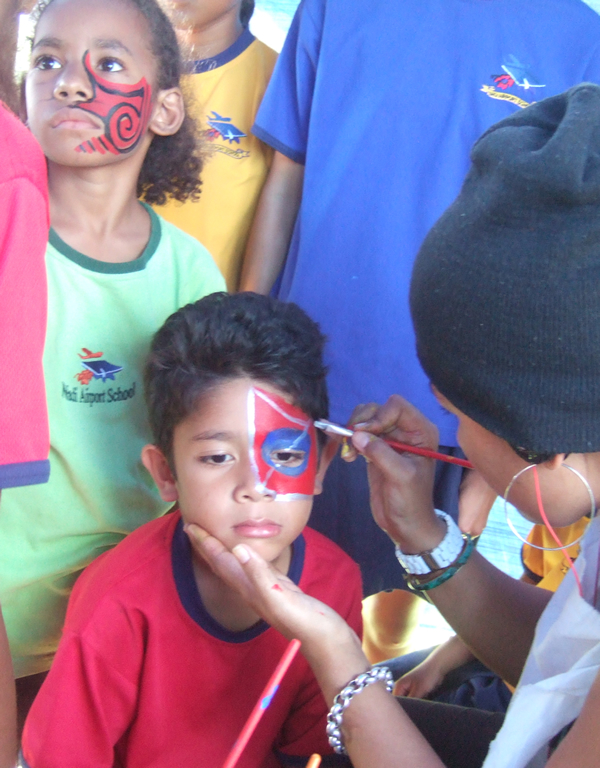
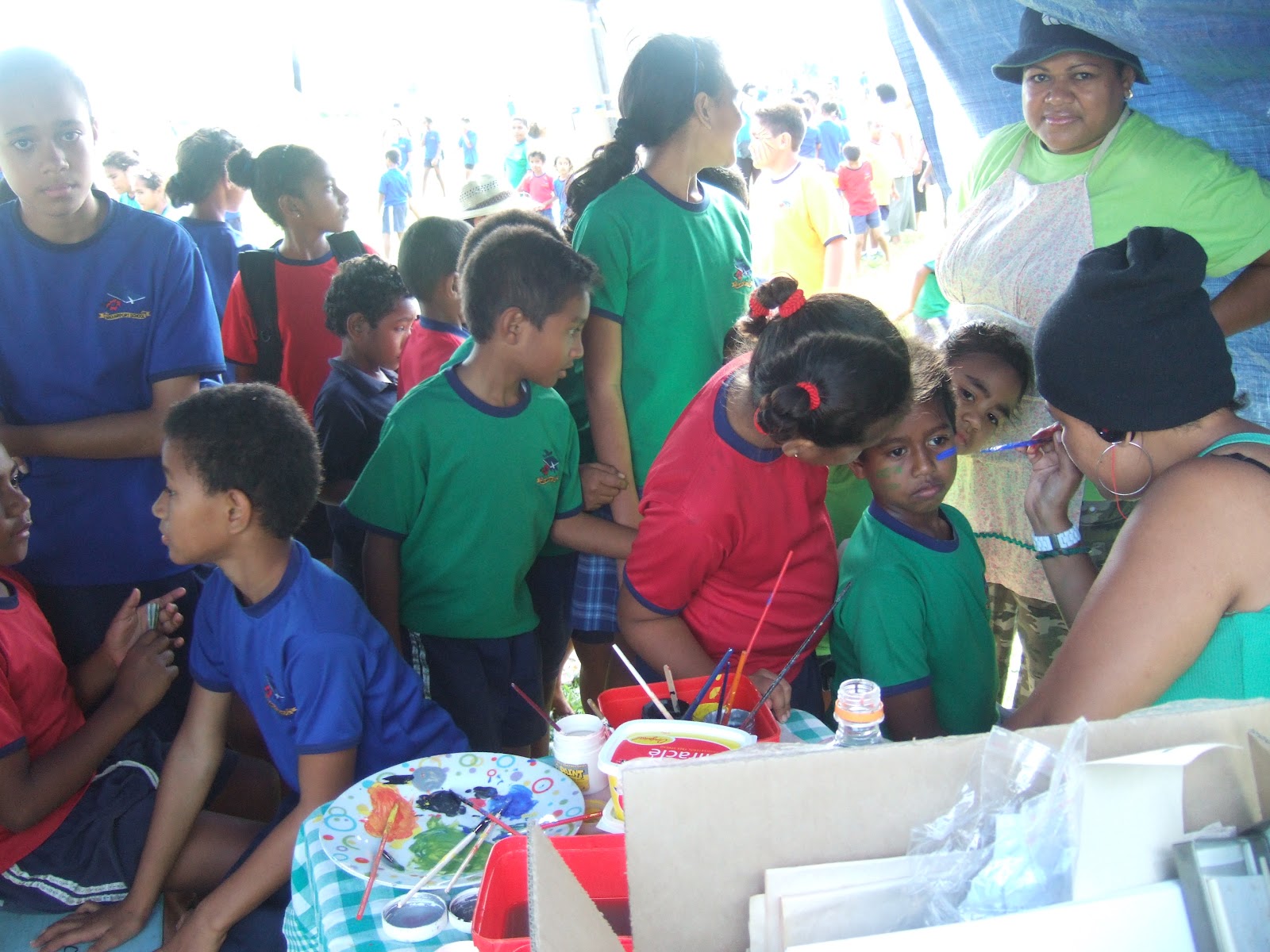
It was a very different Friday for some of the Sigavou Studios team this week!  We had great fun painting about 150 eager young faces at the annual Nadi Airport School Athletics Day!  Rallying in support of this much anticipated event at my daughter's school, we enjoyed bright sunshine, contagious excitement, and loud cheering as each of four "Houses" competed for the best medal tally.  Quick and easy team stripes were what most children wanted, while others opted for trendy tattoo-inspired designs.  Butterflies were in high demand too, and we found out that Spiderman never seems to grow too old when it comes to choosing a role-model to emulate!

Here are a few snaps taken when I occasionally remembered to put down my brush and take out the camera:


Worn out with all the Sports Day excitement, this little onlooker took an impromptu nap at our face-painting table!


Saturday, 26 May 2012

JELLY FISH GALORE!

Over the last few days, our local beach has been dotted with Crown Jellyfish (Netrostoma setouchina).  Perhaps this seasonal invasion has something to do with the "cold" winter temperatures we have been experiencing recently (lows of 17' C at night) - would be interesting to know!  


Many haven't survived being washed ashore, but others can be observed, swimming in the shallow water, their umbrellas undulating - like hula dancers wearing lacy purple tutus! 


Hmmm - I can see the components of a great silk painting here!
 Recent beach walks with my kids and their friends have become mini rescue missions as we try to return jellyfish left stranded by receding tides back to deeper water...  (no long, stinging tentacles with this variety!)


Wailoaloa Beach, Nadi, May 2012

Tuesday, 22 May 2012

FROM VATULELE VILLAGE TO NEW YORK CITY... WITH LOVE

It's been fun working on another painting in my "Reki! ~Time to Dance" series.  This one will be transiting the globe in a few days time - keenly awaited by a client in New York City.

Last month, the fiber used to make the paper I am painting on here was the live, growing inner bark of a leafy green tropical mulberry sapling, in a family-run plantation on a small, coral atoll to the south of our island, called Vatulele.  The bark was harvested by my husband's aunt Mala, one of many women from the seaside village of Ekubu who make a living producing hand-crafted masi, or barkcloth, using an environmentally-friendly, but laborious process of scraping, soaking, beating, and felting the fibrous mulberry bark into long, textured sheets.  This traditional craft is practiced in only a few parts of Fiji, with the knowledge and skills involved being passed down from generation to generation of hard-working women.


Mala came across to the mainland by boat during the recent school break, bringing two of her children for some sight-seeing, and a big roll of lovely white masi to sell in order to raise money for school fees and other family needs.  Our studio is filled with the pungent scent of freshly beaten masi every time we get such a delivery.  It is an honour to be able to work with a material that is as steeped in culture and tradition as our Fijian masi is!
 

"Reki! ~ Time to Dance" - a work in progress...
Size: 46 x 46 cm  Medium: Acrylics on traditional Fijian barkcloth


 Watch this space for some pics of the end result!


Saturday, 5 May 2012

DURUKA SEASON

It's duruka season here in Fiji!  Duruka (Saccharum edule) is one of the weirder, highly delicious vegetables that form part of the traditional Fijian diet.  When it comes into season around April / May each year, you will often see teepee-shaped  bundles of green daruka stalks lined up for sale at rural bus stops and in front of the lean-to vegetable stands that punctuate the verges of our roads here in Fiji.  Here's the bundle I bought from an old farmer selling vegetables door to door in our neighborhood the other day:


During my childhood in rural Pennsylvania, USA, being outdoors in nature was a big deal:  we spent several summers trying out various recipes from "Stalking the Wild Asparagus" by Euell Gibbons - an American classic on living off the land.  One of the more memorable dishes featured in that book was young cat-tails (bull-rush flowers) boiled and eaten with melted butter and salt like corn on the cob.  I was therefore delighted to find something of an equivalent here in Fiji when we moved here twenty years ago!

Duruka, a tall, grass-like plant, generally grows wild in damp soil.  The part that is eaten is the unopened flower, which must be removed from its sheath, as you see my husband doing here:


The most popular way to prepare duruka is boiling it for about ten minutes in coconut cream, adding sliced onion and possibly a little crushed ginger root, for extra flavor. Most Fijians will insist on eating it with fish - though roast chicken and boiled dalo (taro root) were the accompanying dishes for Sunday lunch at our house today!

Ready for the pot...
Boiling our duruka in coconut cream - YUM!!


Tuesday, 1 May 2012

CATCHING UP WITH ALIFERETI MALAI

The table on our porch has become a temporary art studio for visiting family friend and fellow Fiji artist, Alifereti Malai.  Based in Fiji's capital city, Suva, for many years now, Alifereti hails from Burelevu, a small village in the highlands of Ra, on the northern side of Viti Levu. Alifereti and my husband went to school together, where he was known for his amazing portraits, drawn in pencil at the back of exercise books!
Aliferti at work in our studio porch
 Alifereti has been a regular participant in many of the craft fairs and exhibitions we have organised over the past decade.  Until recently, his trademark product was fine drawings in black ink on white Fijian barkcloth, mostly of Fijian artifacts such as war clubs, cannibal forks, and whales teeth pendants. (Note the bookmarks Alifereti is designing in this photo.)  However, over the past couple of years, Alifereti has ventured into painting in oils and acrylics on canvas, using a broader colour spectrum and incorporating abstract elements alongside the cultural  references that are at the heart of this indigenous Fijian's creative work.  It has been fascinating watching this metamorphosis in the style and expressive quality of Alifereti's work!
Oils on canvas by Alifereti Malai exhibited at CreatiVITI's "Art on the Island V" exhibition in 2010
 Hand-drawn barkcloth maps of the Fiji Islands, full of incredible detail, are another line of work for Alifereti.  Below, my studio staff view his latest creation.  The framed map shown here has had pride of place on our studio wall for several years now...


  Alifereti Malai can be contacted by e-mail at alifereti.malai118@gmail.com,
or by mobile phone: (679) 963 7076


Monday, 23 April 2012

EASTER LEGACY

Been working on a new piece called "Easter Meditation" - in acrylics on dyed barkcloth.
The inspiration for the design of this piece, commissioned by a New Zealand based customer with Fiji roots, is from two corners of this planet: our local traditional Fijian masikesa designs, and a piece of African tapestry with it's bold shapes and warm colour combinations...


Tuesday, 10 April 2012

FIJI BITTER BOTTLES IN DYES ON SILK

I've been working on a silk painting commissioned by clients from New Zealand.  They wanted a brightly-colored  feature piece for their living room wall, along the lines of something they spotted in my portfolio.  This one was to portray aspects of my clients' Fiji experiences that are of special meaning to them - including not only a carved tanoa for serving our traditional kava drink, but a bottle of Fiji Bitter!  I included the couple's hand prints, creating what I hope will become a family heirloom... 

Here it is, in various stages of completion: